My Growth-Focused SIPP Has Four Risk Sleeves
My self-invested personal pension is built to maximise growth and convexity, but not by treating every risk as the same bet. Each sleeve has its own job, payoff profile, and risk control.

These are personal research notes, not investment advice. Please read the investment disclaimer before acting on anything here.
For background on how these notes are created, see the About page. I am not a stock analyst. I am sharing these notes partly as memory joggers for myself and partly because I have learnt a lot from other private investors sharing theirs.
The SIPP is growth-focused, but risk management becomes weak if it is copied across unlike positions. A tiny explorer, a profitable small cap, a money-market fund, and a Bitcoin proxy do not fail in the same way. They should not be managed as if they do.
Small cap is the obvious example. A pre-revenue explorer that may never get financed and a cash-generative producer on a low multiple can both be small caps. They are not the same position, and they should not be sized as if they are.
That was the point of the EST / HREE / THX comparison. Two names belonged in the lottery-ticket sleeve. One belonged in the operating-business sleeve. Same broad market bucket, different failure model.
This is the broader SIPP policy that sits behind that distinction. SIPP here means self-invested personal pension. The policy is not trying to be elegant. It is trying to keep four different jobs from blurring into one vague appetite for risk.
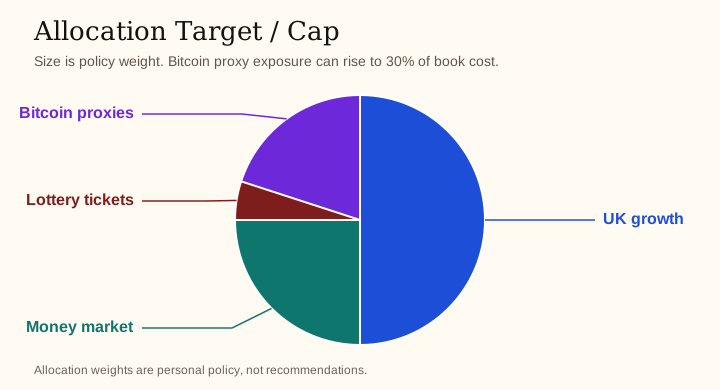
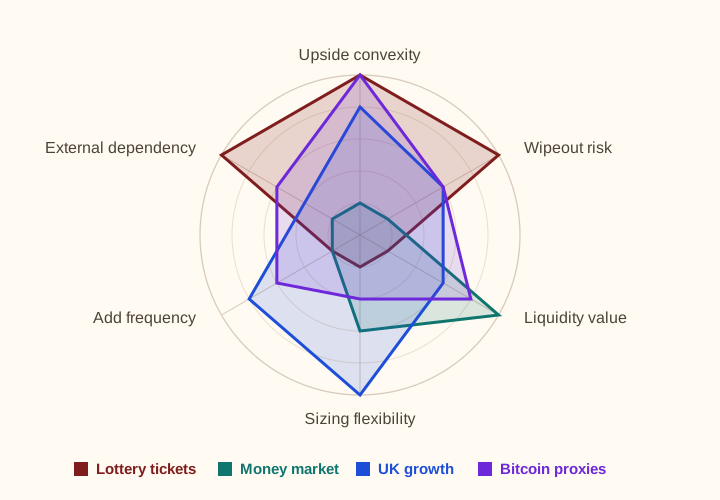
The two visuals show the allocation limits first, then the risk properties behind them.
The radar is illustrative: farther from the centre means more of that property.
Lottery Tickets
This sleeve is capped at 5% because the expected distribution is deliberately harsh: most names disappoint, a few need to carry the basket, and wipeout is part of the model.
The detailed rule lives in the lottery-ticket sizing note, but the SIPP-policy version is simple: initial positions are usually about 0.33%, I avoid owning too many versions of the same risk, and I rarely add unless the business and chart both improve.
In this policy, the sleeve exists to preserve upside optionality without letting speculative stories dominate the account.
Money Market Funds
The money-market sleeve is obviously non-growth. It is there because I may want liquidity.
I am close to a personal decision window around taking a pension commencement lump sum, commonly called a tax-free lump sum. GOV.UK says you can usually take up to 25% of the amount built up in a pension as a tax-free lump sum, subject to allowances and scheme rules, and HMRC's pensions manual describes the formal pension commencement lump sum conditions. GOV.UK also notes that when you can take your pension depends on scheme rules and is usually 55 at the earliest, while HMRC guidance says the normal minimum pension age rises from 55 to 57 from 6 April 2028.
That timing makes liquidity valuable. I may put the lump sum towards an apartment for my offspring. I may move some capital into a taxable brokerage account. I may do neither. The point is not to forecast markets. The point is to avoid being forced to sell risk assets at the wrong time just because a personal capital decision arrives.
High-Growth UK Small Caps
The high-growth sleeve is where I want the main compounding to happen.
It is not a bucket for every exciting small company. The rule is stricter: they must have revenue, be profitable, and show strong signs of growth. The technical setup matters too. Entry and add points should come from early- to mid-stage bases where the risk is defined.
The sizing method is different from the lottery-ticket sleeve. For a proper operating business, the whole position is not automatically the risk. I can set an entry, define a stop loss, and reverse-engineer position size from the acceptable portfolio loss between the two. I have put the basic arithmetic on the investing calculators page.
When this part of the portfolio is fully working, combined risk from entry to stop loss could be 10-20%. The difference is that the risk is attached to operating businesses with revenue, profit, and growth, not to speculative stocks where the risk set is more binary and less controllable.
Bitcoin Proxies
This is a long-term, committed bet through indirect exposure rather than spot Bitcoin inside the SIPP. The current names are COIN, MSTR, and MSTY. I do not treat Bitcoin itself as a high wipeout-risk asset, but these are not Bitcoin. They are companies, balance sheets, strategies, and wrappers that can fail in their own ways.
I have booked plenty of profit over time, but the current positions are materially underwater. I continue to add at lows, while keeping the sleeve bounded. My rule is a 20% target with a maximum of 30% of book cost. If it grows beyond that through price movement, that is a different problem. I do not want repeated adds to turn a theme I like into the portfolio itself.
Wired for Growth
The policy is built around one idea: maximise upside, but make each risk control match my market beliefs about the sleeve.
The policy keeps the jobs separate when a new idea looks tempting, so the difference is visible before I add capital, not afterwards.