HREE: Big Rare-Earth Project, Bigger Financing Gap
Harena is a Madagascar rare-earth development equity with project numbers large enough to justify a tiny speculative position. It also has the kind of funding gap that can leave those numbers disconnected from the equity for a very long time.

These are personal research notes, not investment advice. Please read the investment disclaimer before acting on anything here.
For background on how these notes are created, see the About page. I am not a stock analyst. I am sharing these notes partly as memory joggers for myself and partly because I have learnt a lot from other private investors sharing theirs.
Most of these names start as raw ideas from Jason Needham’s Trading Bases membership. Before I buy, pass, or replace an existing holding, I review the business case and risks for myself and check them against my remaining risk budget and the major index trend models that guide how much exposure I want on.
What It Is
Harena Rare Earths is a Madagascar rare-earth developer built around the Ampasindava ionic clay project. This is a development-stage company, not a producer. It does not have meaningful turnover; the equity case depends on moving a rare-earth project far enough along the technical, financing, and permitting path to make it more valuable to the market or to a strategic backer.
Ampasindava is at pre-feasibility study (PFS) stage rather than production or construction stage, with a reported resource of about 699Mt at 868ppm total rare earth oxides (TREO), containing roughly 606kt TREO. The listed equity is a claim on whether that development path gets financed and advanced. The economic attraction is rare-earth magnet exposure, especially neodymium-praseodymium (NdPr) and the heavier rare earths dysprosium and terbium (DyTb).
Why It Is Interesting
Ampasindava’s January 2026 PFS showed a 20-year mine life, US$142m pre-production capex, US$249.6m post-tax net present value at a 10% discount rate (NPV10), 30% post-tax internal rate of return (IRR), and 4-year payback. Against a market cap around £19m, the upside asymmetry is the point.
Permanent-magnet demand comes from electric vehicles, wind power, industrial electrification, robotics, and some defense-adjacent systems. NdPr is central to that demand. DyTb helps those magnets hold performance at higher temperatures. Non-China sources are limited, so a project that starts to look financeable can attract attention far out of proportion to its current market cap.
Why It Could Fail
US$142m of capex against a company with no meaningful turnover and a market cap around £19m is not a normal operating challenge. The project is likely to depend on capital markets, strategic backers, or development finance staying open and interested.
That creates multiple failure paths: dilution, permitting problems, weak strategic interest, or the market losing patience. A project can look statistically cheap for years while the listed equity remains a poor bet.
Financial History
The project economics are large, but the listed vehicle itself remained weak and cash-poor.
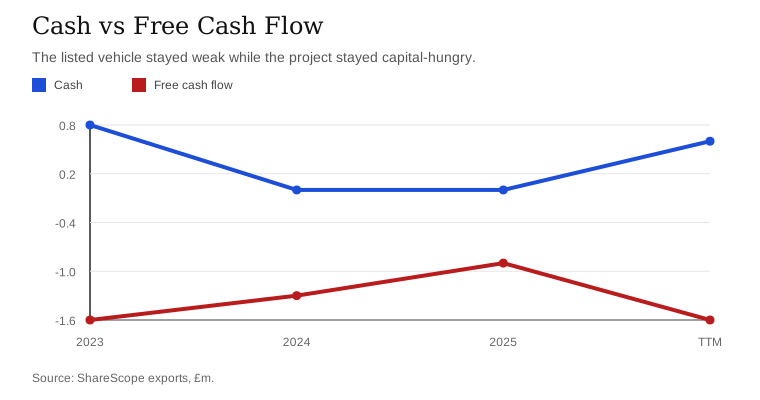
Cash stayed low and free cash flow stayed negative throughout. That is why the PFS valuation is not enough on its own.
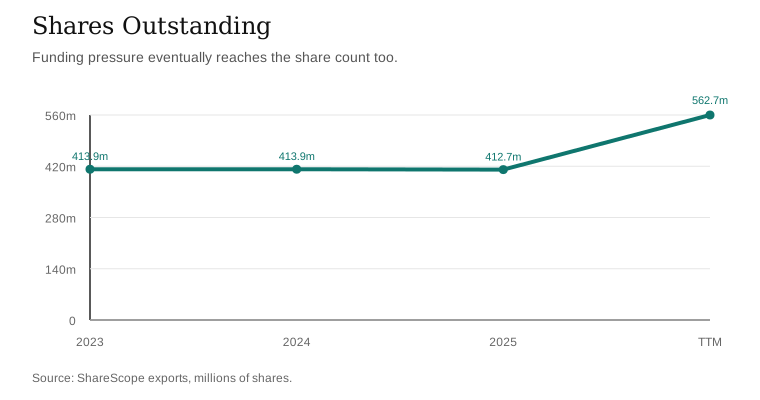
Project / Asset Snapshot
| Item | Figure |
|---|---|
| Project stage | PFS |
| Reported resource | 699Mt at 868ppm TREO |
| Contained TREO | about 606kt |
| Mine life in PFS | 20 years |
| Pre-production capex | US$142m |
| Post-tax NPV10 | US$249.6m |
| Post-tax IRR | 30% |
| Market cap at time of note | about £19m |
| Recent funding | £450k at 1.5p; £2m at 2.2p |
Why It Fits My Portfolio
This belongs in the lottery-ticket sleeve because the upside is non-linear if the funding and strategic pieces line up. I do not think I have an edge in rare-earth project finance. Here, about 0.33% of the portfolio is the whole position size, not just the risk-to-stop-loss budget. The position has to stay tiny because the downside is not just "project delayed"; it is "the equity gets diluted or stranded while still looking attractive on paper".
It also occupies a slot in the speculative mining sleeve. If I already have enough exposure to binary funding stories, the right answer to the next interesting rare-earth or development project may be abstention, not accumulation.
Memory Jog
Bought as a binary strategic-financing ticket. The upside sits in the project economics; the downside sits in a tiny, loss-making, capital-hungry listed company trying to bridge a very large funding gap. If the funding path does not improve, the right mental model is not "cheap rare-earth project" but "small equity sitting under a very large capex requirement".
Triggers To Revisit
- evidence of project finance, strategic funding, or development finance support
- permitting progress in Madagascar
- offtake or strategic partner announcements
- equity raises below prior funding levels
- changes to project economics, capex, or rare-earth pricing assumptions